iPhone + Apple Watch · Coming to the App Store
Every real PR.
Counted.
Most trackers keep one number per lift. Callus keeps every set no other set dominates — and notices when you set records on a cut.
- 130×10 PR
- 120×14 PR
- 90×16 PR
Four records. One lift. That's the point.
- Set types
- 10
- Achievements
- 51
- Challenge types
- 12
- Import formats
- 4
- Ads. Ever.
- 0
- Account required
- No
The PR engine
A set is a record
if nothing dominates it.
Every set you've logged. One lift.
Reps across the bottom, weight up the side. A year of work under the bar.
Most apps keep one number.
Your heaviest single. Hit 140 once and the app stops noticing — five-rep grinders, twenty-rep widow-makers, none of it reads as a record.
Callus keeps the frontier.
A set is a PR if no other set has both more weight and more reps. Your 7-rep max and your 30-rep max are records in their own right — held at the same time, ranked by estimated 1RM.
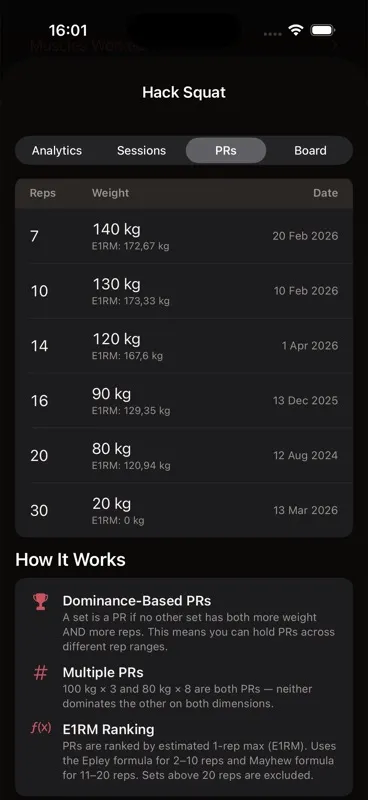
Straight from the app — the PRs tab keeps the whole frontier.
Cut-era PRs
Cutting? Every other app
thinks you're getting weaker.
Callus notices the opposite.
No toggle. It just notices.
Four weeks of bodyweight trending down around two percent and Callus flags the cut on its own. You never tell it you're dieting.
PRs, judged per kilo of you.
Relative mode scores records by weight ÷ bodyweight — with DOTS and e1RM-per-kilo trends over time. During a cut, your Hall of Fame switches to relative on its own.
Deficit records get banked.
A record set while cutting is tagged a cut-era PR and kept. Lighter on the scale, stronger on the bar — that's the proof most apps throw away.
What your Apple Watch announces — with a double haptic — the moment you set a record in a deficit.
Relative and cut-era features need bodyweight data — Apple Health or manual entries.
Logging depth
Deep enough to hold
how you actually train.
Ten set types. The real ones.
Working, warmup, dropset, rest-pause, mechanical dropset, myo, failure, forced, paused, partial. Dropsets carry weight, reps and RPE per drop; rest-pause carries cluster reps and RPE.
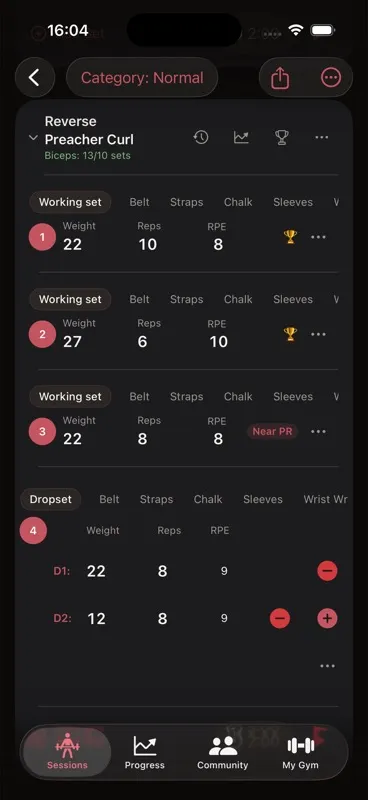
Your last session, already typed in.
Prefill materializes your whole last workout as placeholders. Type your reps and the weight confirms itself. Autosave runs 1.5 seconds after you stop. There is no save button anywhere in the app.
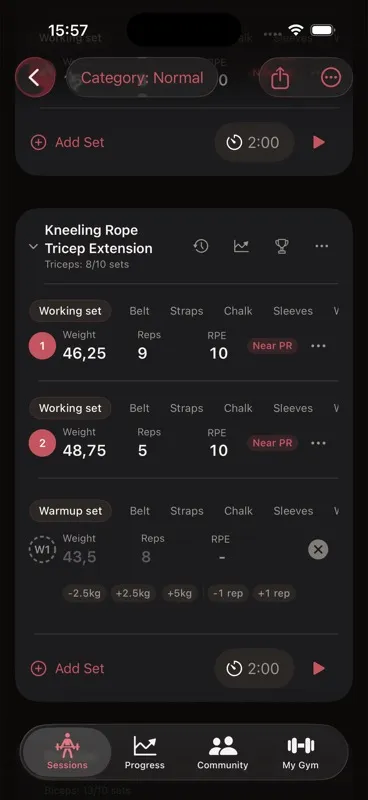
It tells you when history is close.
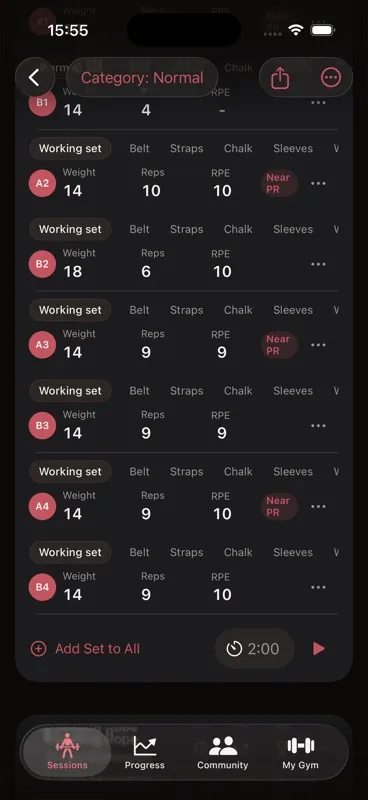
Near-PR badges appear mid-set, while the plates are still on the bar — one more rep, or one more kilo, makes it a record.
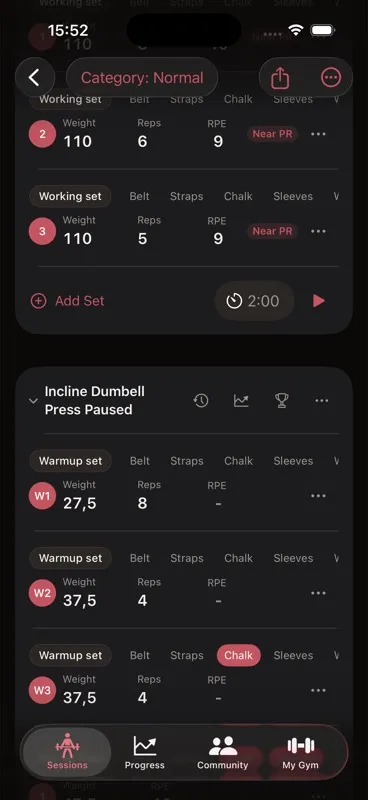
Supersets, scored by rounds.
A1 with B1, A2 with B2 — paired the way you actually run them, with the rest timer riding along.
The coach's eye
Coaching that shows its work.
Not AI guesses. Your actual data, with receipts — every signal carries its reason, every formula is explained in the app.
Deload triggers
Each with a cause you can read, a concrete prescription, and one-tap activation. Charts and trends exclude deload sessions, so backing off never reads as backsliding.
Recovery signals
One readiness score from sleep, HRV, resting heart rate, wrist temperature, respiratory rate and more — and when you're cutting, it knows a struggling lifter needs a diet break, not a deload.
Plateau forecast
It reads your e1RM trend and calls the stall weeks before you hit it — then tells you what to change, with RPE-aware "try this next" suggestions.
Milestone dates
Projected dates with confidence bands for the numbers you care about — your first 100 kg bench, a double-bodyweight deadlift.
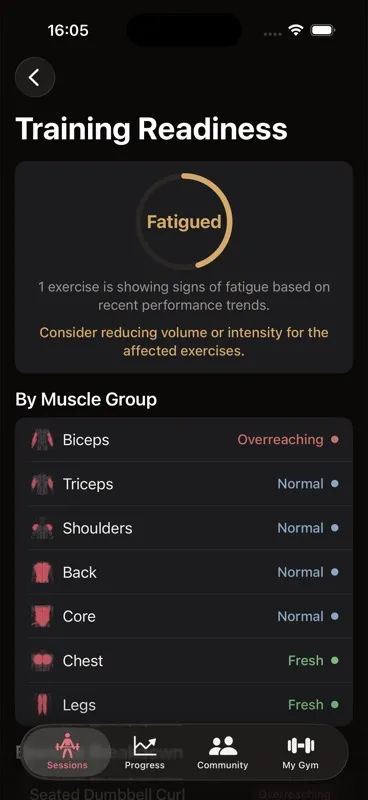
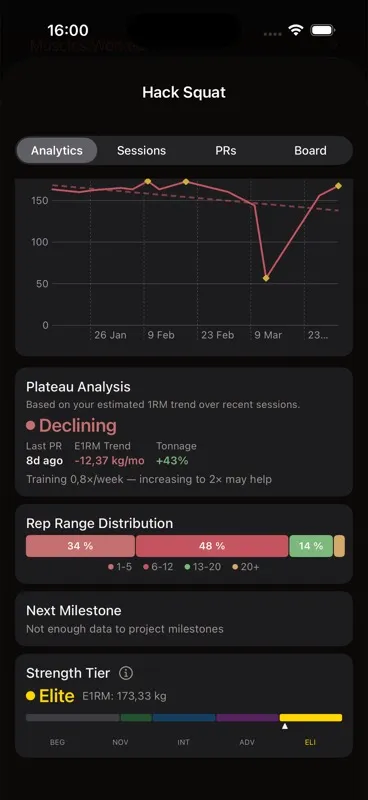
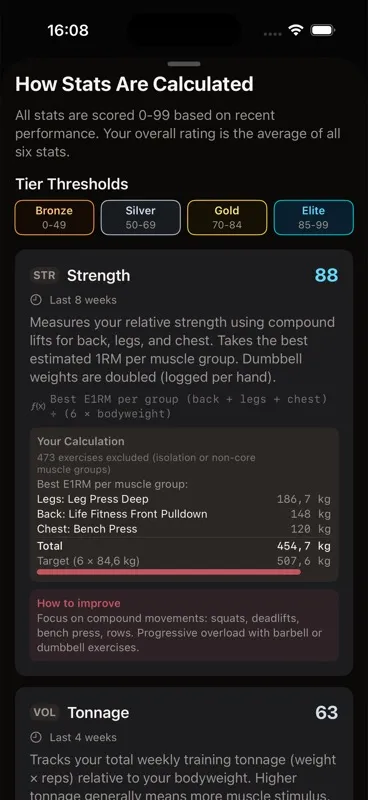
Thresholds cite the literature — Helms · Israetel · Zourdos · IPF DOTS.
The sport
Lifting is better as a sport.
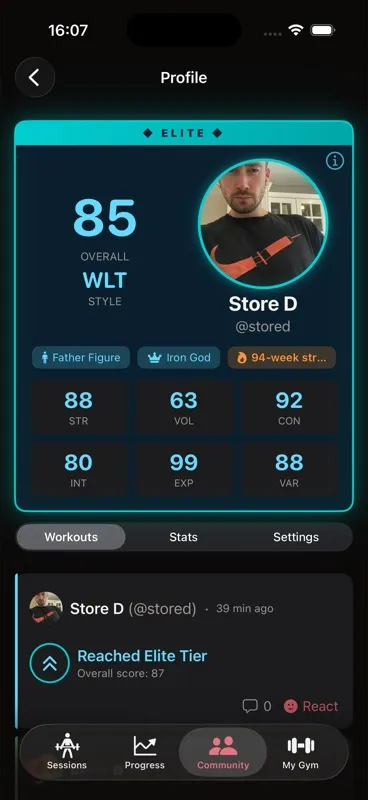
A lifter card, not a profile page.
Six stats rated 0–99 — strength, volume, consistency, intensity, experience, variety. Bronze to Elite. Your training style on the banner, your badges and streak underneath. The card is who you are under the bar.
- 51 earnable achievements, across six categories.
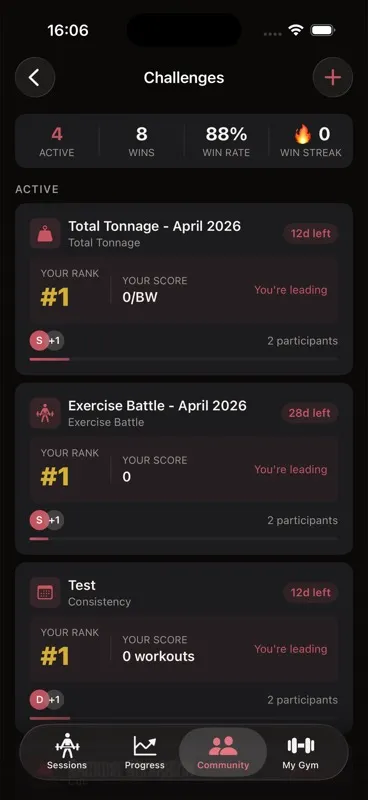
- 12 challenge types for your squad — Grind King, Heavy Single, Cut Challenge…
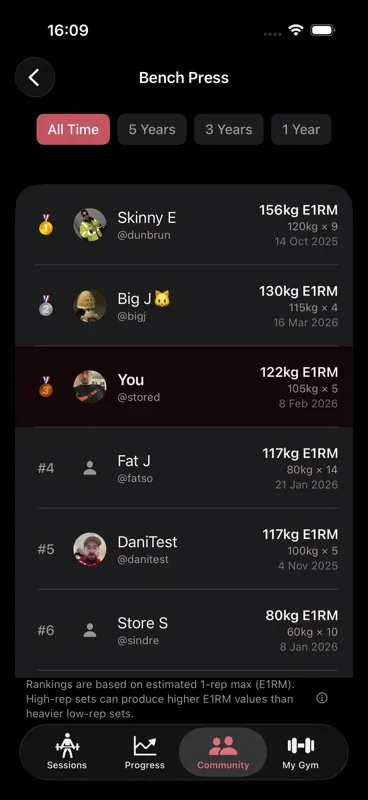
- ÷BW leaderboards ranked by a bodyweight-aware score. Strength decides — not size.
All of it optional. The logger is complete without it.
Apple Watch
Phone in the locker.
Sets still counted.
0.5 → 2.5 → 5kg
Crown steps that adapt — fine near your working weight, coarse when you're loading plates.
The wrist does the work.
Confirm, edit, add and undo sets without touching your phone. The rest timer rides along.
A queue that doesn't forget.
Every command persists on the watch, dedupes, and replays when your iPhone is back in range. Log a whole session with the phone in your locker — nothing goes missing.
It celebrates the hard ones.
Set a record in a deficit and the watch calls it: CUT-ERA PR, with a double haptic, the moment the set is confirmed.
Callus on Watch is a companion app — it pairs with your iPhone.
Trust
The proof is yours.
-
No account required.
"Continue offline" is the onboarding button, not a buried setting. The free tracker is complete without ever signing in.
-
No ads. No trackers.
Zero ad or tracking SDKs in the app. Crash reporting is opt-in and off by default. The business model is a subscription, not surveillance.
-
Sync on your terms.
No account? Nothing leaves your phone. Sign in on the free tier and your last 15 workouts sync; full-history cloud sync is Pro.
-
Import your history.
Strong, Hevy, RepCount, Lyfta — bring years of training in minutes, free. Switch from Hevy Switch from Strong
-
Export everything.
CSV and full JSON, free, anytime. If you ever leave, your log leaves with you.
Pricing · planned, final at launch
Free because the tracker is yours.
Pro because the coaching is work.
Free
$0
A complete tracker. Not a demo.
- Unlimited logging — all 10 set types
- The full PR engine, relative & cut-era included
- Apple Watch companion app
- Prefill, autosave, near-PR badges
- Recovery rings & plateau-forecast badge
- Charts at 1M / 3M ranges
- CSV + JSON export · 4-format import
- Apple Health sync · Live Activity rest timer
- 5 templates · 5 friends · join one squad
Pro
$6.99/mo
or $39.99/yr — 7-day free trial on annual
- The full coach's eye — deload prescriptions, recovery score, plateau forecasts, overload suggestions, milestone dates
- Full chart history
- Cloud sync of your entire log
- Training programs
- Unlimited templates & friends
- Per-exercise rest timers
- Create squads & challenges
- Extra share-card themes
Free users see the coach's teasers as their own real numbers behind a blur — never sample data.
FAQ
Straight answers.
When does Callus launch?
It's in final pre-launch testing for the App Store. The waitlist hears first — and gets the first invites.
Is there an Android, iPad or web version?
No. Callus is built for iPhone and Apple Watch, and that focus is deliberate.
Do I need an account?
No. "Continue offline" is the onboarding button. An account only exists for the social layer and sync — and the free tracker is complete without one.
How do PRs work?
A set is a PR if no other set has both more weight and more reps — so your 3-rep max and your 10-rep max are both records, held at the same time and ranked by estimated 1RM. Flip to relative mode and records are judged per kilo of bodyweight.
What does the cut detection actually do?
If your bodyweight trends down around two percent over four weeks, Callus flags a cut on its own — no toggle. Records you set in the deficit are tagged cut-era PRs, your Hall of Fame switches to relative scoring, and your Apple Watch celebrates cut-era records the moment they happen. It needs bodyweight data, from Apple Health or manual entries.
Can I bring my data from another app?
Yes — import from Strong, Hevy, RepCount and Lyfta is free. Export is free too: CSV and full JSON, anytime.
What happens to my data?
Everything lives on your phone first. No account? Nothing leaves it. Signed in on the free tier, your last 15 workouts sync; full-history cloud sync is Pro. No ads, no tracking SDKs, and crash reporting is opt-in, off by default.
What will Pro cost?
The planned pricing is $6.99 a month or $39.99 a year, with a 7-day free trial on the annual plan. Final pricing is confirmed at launch.
The waitlist
Be first under the bar.
Callus is in final pre-launch testing. The waitlist hears first — and gets the first invites.
Launch news only. No spam, ever.